From Sounds to Script: How Montessori Children Learn to Write
February 16, 2026

In Montessori classrooms, the process of writing begins long before children begin to hold a pencil. We start with rich oral language experiences, exploration of sounds, joyful movement, and a growing awareness that the symbols of written language carry meaning.


By the time children begin the
recording process, that is, writing words on a surface, they have already done enormous preparation. They know the sandpaper letters so well that they can trace them blindfolded or “write” them in the air. They have composed countless words using the Moveable Alphabet, experimenting with sounds and meaning long before their hands are ready for conventional writing.


And then… one day… they are ready to put chalk to board.


This is the beginning of a beautiful and empowering journey.


The Materials That Support the Journey


To help children make the transition from forming words with the movable alphabet letters to recording them on a surface, we offer a thoughtfully prepared environment that can include:


  • Small chalkboards (blank, lined, or squared)
  • Large wall-mounted chalkboards
  • Containers of sharpened chalk and half-erasers
  • A writing supply station with paper in various narrow sizes
  • Pencils and underlays as needed
  • Accessible writing surfaces around the room


These materials invite practice without pressure, exploration without permanence, and repetition without fatigue, all of which are essential at this stage of development.


Step One: Writing Words with Chalk


When a child has composed a list of words with the Moveable Alphabet, the guide gently introduces the chalkboard:
“Let me show you something you can do with the words on your rug.”


The child brings one word to the table, and the guide may make a point to notice how the letters connect and flow. With a piece of chalk in hand, the child can attempt to write the word on the chalkboard. For many children, this moment is astonishing, as they suddenly realize, “
I can write!”


Over the next several days, the child chooses words, writes them, erases them, and writes again. During this time, the child naturally refines:


  • the direction of writing,
  • the connection between letters, and
  • the placement of letters along an invisible horizontal line.


This is joyful, purposeful work. And the chalkboard provides endless opportunities for clean slates!


Step Two: Introducing the Baseline


Once the child is comfortably writing words, we introduce the idea of a baseline, which is the line on which most letters sit.


We use a simple ruler to draw a single line across the chalkboard and explain: “
I’m using this line to show where the letters sit.” 


The child thus begins to understand that writing follows a structure, including the realization that letters aren’t merely floating symbols but exist in space in predictable ways.


Step Three: Baseline and Waistline


As the child’s control increases, we add a second line: the waistline. This is the space where most lowercase letters rise up to, and introducing it helps children refine the size and placement of their script.


Using pastel chalk, we shade the space between the baseline and waistline, giving a soft visual guide. Over the next several days, the space becomes a little narrower. And then narrower still.


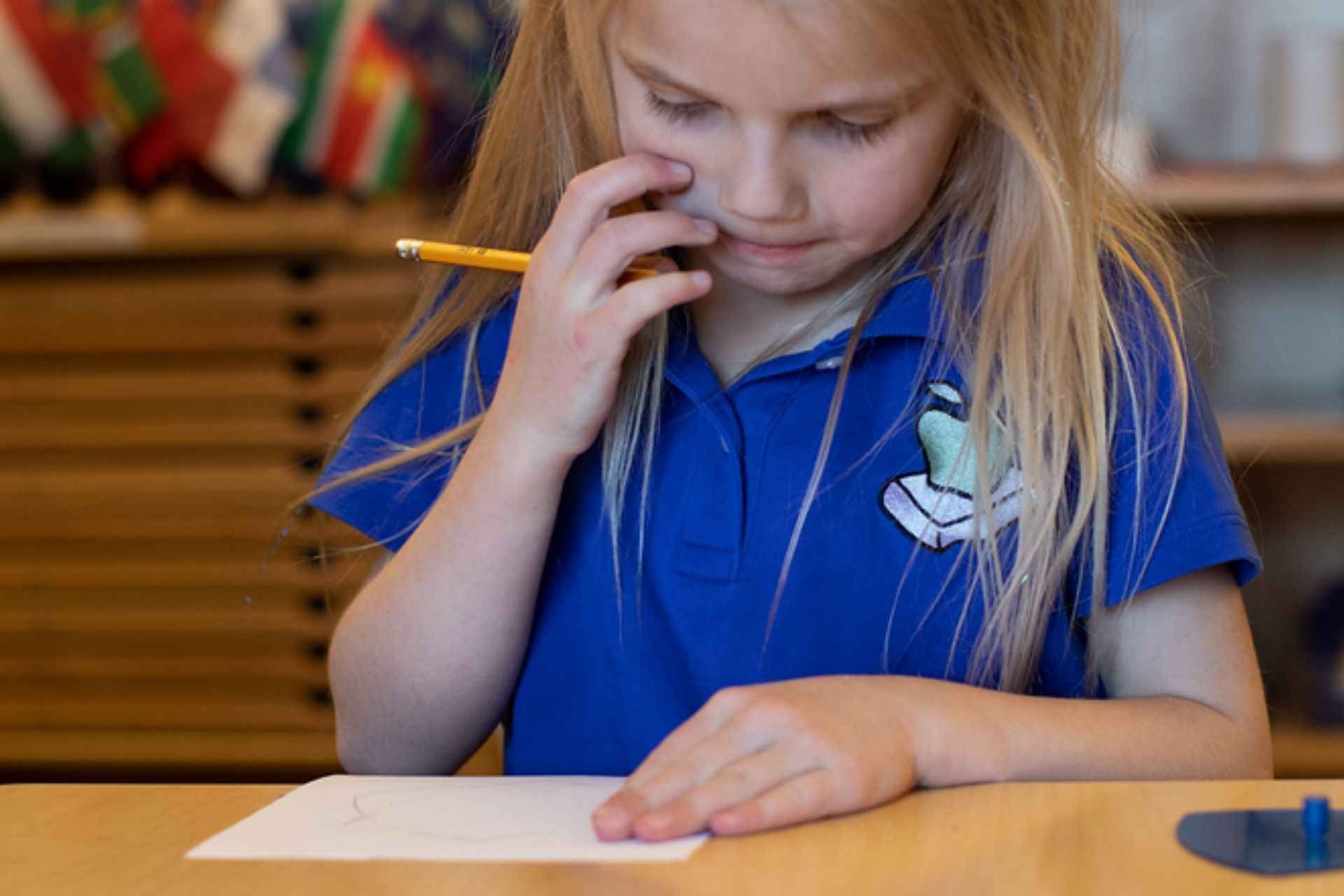
Eventually, the child works confidently on a nine-lined chalkboard, and from there, we transition to paper. Many children around five-and-a-half naturally begin to prefer writing directly on paper rather than returning to the Moveable Alphabet. They have internalized the shapes of letters, the structure of words, and the flow of writing.


It is important to remember: the natural size of children’s script varies. Some begin writing very small, others larger. We follow the child rather than a rigid sequence.


The ultimate goal is simple and elegant: to write confidently on a single line.


What This Work Supports


A child who moves through this sequence with joy and readiness:


  • develops beautiful, legible handwriting,
  • gains confidence in written expression, and
  • understands that writing is a tool for communication.


This is monumental work for a young child. It marks the moment when their mind and hand unite to express their own thoughts. Most importantly, writing unfolds naturally when the groundwork has been laid with care.


Schedule a tour of our school in Auburn or Worcester to see how we honor this journey with care and intention. 


Adult warmly greets child after school, supporting calm transition and connection
February 9, 2026
Learn why children need quiet decompression after school and how a “quiet landing” supports regulation, connection, and meaningful conversation.
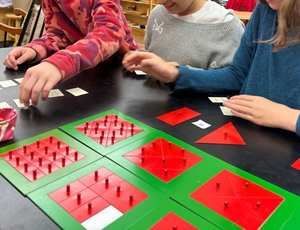
Children explore geometric equivalence using Montessori fraction and area materials.
February 2, 2026
Discover how Montessori geometry introduces equivalence through hands-on exploration, helping children build deep understanding of area, fractions, and mathematical reasoning.
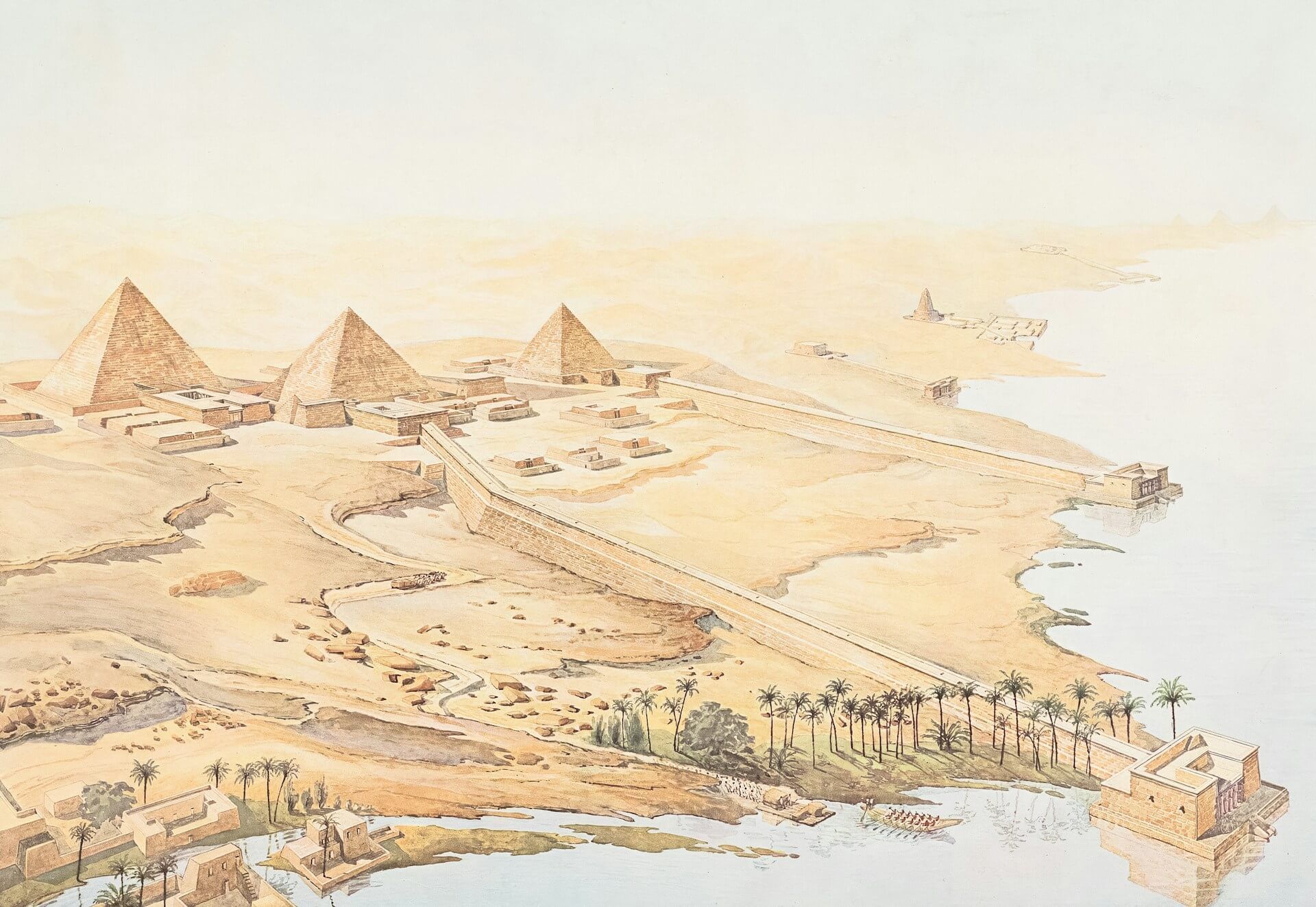
Illustration of ancient Egypt with pyramids and waterways, showing early geometry origin
January 26, 2026
Explore the Montessori story of geometry’s origins, from ancient Egyptian rope-stretchers to modern classrooms, inspiring children’s wonder and curiosity.
Child with crossed arms and an upset expression, showing big emotions during a challenging moment.
January 19, 2026
Few experiences challenge us adults more than feeling disrespected by our children. When a child talks back, shouts hurtful words, or responds with anger, it can strike at the heart of our sense of connection. Yet when we examine these moments more closely, they often reveal something deeper: a child struggling with big feelings and an adult unsure how to respond without escalating the situation. Montessori education reminds us to look beneath behavior and see the developing child who is still learning emotional regulation, communication, and perspective-taking. Disrespectful words are often less about defiance and more about overwhelm. When Children Say, “I Hate You” Children sometimes resort to strong words when they realize they cannot change an adult’s decision. A request to go to a friend’s house or a desire for more independence can quickly turn into an emotional outburst when the answer is “not today.” For many children, especially younger ones, emotions tend to be extreme. They feel that they love a parent when things go their way and hate them when they feel thwarted. As adults, however, we hear the word hate with its full weight and meaning. Merriam-Webster defines hate as “extreme dislike or antipathy: loathing,” and adults often reserve it for moments of deep hurt. Children do not. They use the word as a blunt tool to express frustration, disappointment, or a sense of powerlessness. Rather than reacting to the word itself, Montessori-informed parenting encourages us to respond to the feelings beneath the word. A calm acknowledgment, such as “You’re really angry right now,” helps our children feel seen and understood. The goal is not to accept disrespectful language but to model emotional literacy. By naming the emotion instead of punishing the outburst, we can show children that big feelings can be handled with clarity and calm. When adults overreact to the word hate, children may learn that it is an effective way to provoke a response. When adults remain grounded, children begin to understand that emotions can be expressed without resorting to hurtful language. When Children Talk Back Those angry last words, muttered insults, or attempts to reopen a closed discussion (a.k.a. ‘back talk’) are often viewed as the pinnacle of disrespect. For adults, it can feel like a direct challenge to authority. For children, however, back talk usually signals that the situation has reached a boiling point. They are overwhelmed, upset by a limit, or trying to have the final say when they feel powerless. Some children also learn that persistent pushback can wear down adults’ resolve. If arguing leads to a changed decision even once, children will understandably try again. One effective approach is simply not to engage. Ignoring back talk while still holding firm to the original limit removes the reward of an emotional reaction. It communicates, “The boundary is set, and I won’t be pulled into a power struggle.” This is not permissiveness. It is clarity. When adults refuse to escalate, children gradually stop using back talk as a tool. Over time, they experience a powerful model of self-control: an adult who remains peaceful, firm, and grounded even in tense moments. Allowing a child to have the last word can feel counterintuitive. Yet it often reduces conflict, shortens arguments, and preserves the adult-child connection. It teaches children that relationships do not depend on “winning” but on mutual respect and emotional resilience. Choosing Connection Over Control Disrespectful language can trigger a strong emotional response in us as adults. It can feel personal, even when it isn’t meant that way. In heated moments, it can help to pause and ask a simple question: Is the goal to be right, or is the goal to remain close? Children need loving boundaries, but they also need adults who can maintain connection even when emotions run high. Responding calmly to disrespect does not mean accepting the behavior. It means addressing the root cause rather than reacting to the symptom. Montessori parenting encourages adults to guide children with both firmness and grace. We focus on teaching children not only what behavior is expected, but also how to manage the feelings that fuel behavior. When adults model emotional steadiness, children learn by example. And as they grow, relationships deepen rather than fracture. Over time, the decision to prioritize connection builds trust, strengthens communication, and helps children develop the internal tools needed for respectful interactions. Visit us here in Worcester and Auburn to see how we help families invest in nurturing long-term relationships!
Toddler pouring water in a Montessori Practical Life activity, practicing independence and coordinat
January 12, 2026
Discover how a Montessori prepared environment—at school or home—supports independence, peace, and purposeful activity through thoughtful design.
Child using Montessori decimal cards to explore quantity and place value through hands-on math work.
January 5, 2026
See how Montessori math builds true understanding through hands-on materials, nurturing every child’s natural mathematical mind from concrete to abstract.
Montessori’s Living Curriculum: Biology in the Classroom & Beyond
June 30, 2025
Experience how Montessori brings biology to life, nurturing wonder, moral awareness, and a deep sense of connection to the living world.
Our Montessori Bookshelf: Wonders of the Natural World
June 30, 2025
Discover beautiful nature books that spark wonder, curiosity, and a lifelong love for the natural world—perfect for Montessori-inspired families!
Wonder and Words: How Montessori Builds Language Through Biology
June 23, 2025
See how Montessori nurtures curiosity and builds a love for biology by connecting hands-on exploration with rich, meaningful language.
A Different Kind of Homework: A Montessori-Inspired Summer
June 9, 2025
Trade worksheets for wonder! Explore our Montessori-inspired summer adventure list to spark joy, curiosity, and real-world learning.
Show More